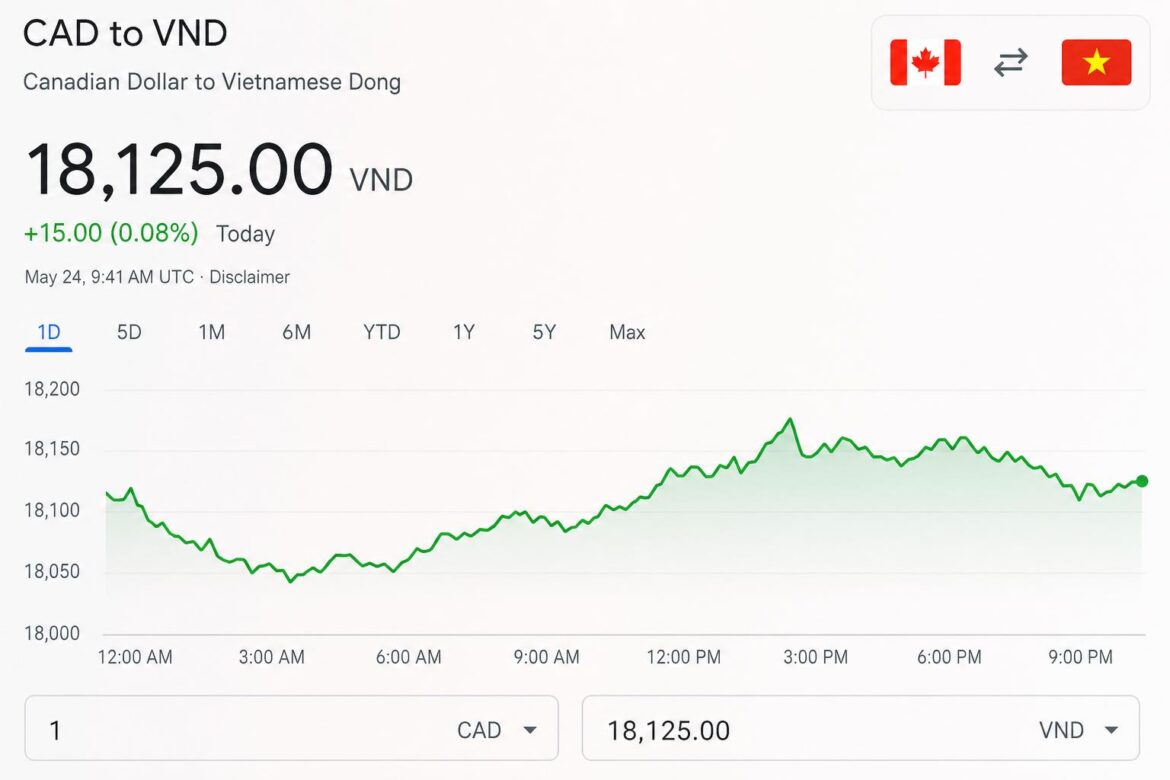
If you’ve ever stood at a cash machine in Ho Chi Minh City wondering how many zeros make a good coffee, or you’ve tried to wire funds to family in Da Nang from Toronto and got lost in fees, this guide is for you. Converting CAD to VND isn’t complicated, but the details matter. Get them right and you save real money, travel smoothly, and avoid the avoidable. Get them wrong and you could pay double-digit spreads, face transfer delays, or carry the wrong bills into customs. This in-depth Canadian guide breaks down how the Canadian dollar to Vietnamese dong exchange works, where to get the best rates, the true costs behind every method, and practical strategies whether you’re travelling, sending remittances, studying abroad, or paying suppliers.
We’ll walk through rate mechanics in plain English, compare ways to convert CAD to VND in Canada and in Vietnam, show step-by-step workflows that cut fees, and flag the real-world traps—dynamic currency conversion, ATM fees that stack, counterfeit concerns, and compliance rules on both sides. You’ll also find tips tailored to Canadian norms, from FINTRAC reporting and CBSA declaration rules to how the Bank of Canada’s decisions can nudge the CAD/VND rate.
What “CAD to VND” Really Means: Rates, Quotes, and the Price You Actually Pay
Every “CAD to VND” quote starts with one reference point: the mid-market rate. Think of it as the midpoint between wholesale buy and sell prices that big banks and currency markets use when they trade with each other. It’s the clean, no-markup price you’ll see on neutral sources like XE, Wise, or the Bank of Canada’s published reference rates. You can treat that as your baseline.
Retail customers—whether at a Canadian bank branch, an airport counter, an ATM in Vietnam, or a remittance app—don’t usually get the mid-market rate. Instead, providers add a spread (their margin) on top, then sometimes layer on flat fees, percentage fees, intermediary bank charges, and receiving fees. The real cost is the combination of spread + explicit fees. A “no-fee” transfer might hide a 3–5% markup in the rate. A “transparent rate” app might charge a small fixed fee. Either way, if you only compare posted rates or only compare flat fees, you can miss the true total.
One more wrinkle: rates move. Currency markets trade 24/5. CAD/VND reflects not only Canada’s economy but also Vietnam’s policies and capital controls. If you plan a large conversion for tuition or a supplier, day-to-day swings can change your budget by hundreds of dollars. We’ll cover strategies to manage that risk—alerts, partial conversions, and forward contracts—later in this guide.
How to Check Today’s CAD to VND Rate (and Why Sources Differ)
Before you convert, check a neutral benchmark:
- Bank of Canada (reference rates; indicative, not for retail dealing): bankofcanada.ca/valet
- XE live mid-market quotes: xe.com
- Wise (shows mid-market rate and fee separately): wise.com/ca
- OANDA for historical charts and averages: oanda.com
Compare that mid-market snapshot to the quote you’re given by your bank, an app, or an exchange counter. The gap—expressed as a percentage—is the spread. Add any fixed or variable fees to see your total cost. For larger transactions, even a 1% difference is material.
Can You Buy Vietnamese Dong in Canada? The Reality on the Ground
Here’s the blunt truth: most major Canadian banks don’t sell Vietnamese dong cash at the branch counter. Some currency exchange boutiques in big cities will advertise VND, but availability is spotty and the spread is often steep. Because VND isn’t a freely convertible, heavily traded currency, Canadian providers rarely hold it in inventory. If they’re willing to order it, expect delays and wide margins.
For travellers, the pragmatic approach is to skip trying to buy dong in Canada. Instead, take a small amount of Canadian dollars or U.S. dollars (clean, recent, unmarked bills) and convert on arrival, or withdraw VND at an ATM in Vietnam using a Canadian debit card. For remittances or larger payments, online money transfer services and bank wires are typically more efficient than hunting for cash dong in Canada.
Ways to Convert CAD to VND: What Works Best for Canadians
Different situations call for different tools. A weekend trip to Hanoi isn’t the same as a tuition payment or a business invoice. Below are the main routes Canadians use to convert Canadian dollars to Vietnamese dong, with the real-world pros, cons, and typical costs.
1) ATMs in Vietnam with a Canadian Debit Card
This is the simplest approach for most travellers. You land, find a bank-branded ATM, and withdraw VND directly from your Canadian account.
Pros: Convenient, generally fairer total cost than airport exchange counters, no need to carry large amounts of cash across borders. ATMs are common in cities and tourist areas.
Cons: Fees can stack—your Canadian bank’s foreign ATM fee, its currency conversion fee, plus a local ATM operator fee (often in the range of 20,000–50,000 VND per withdrawal). Per-withdrawal limits can be low (e.g., 2–5 million VND per transaction), so you may need multiple withdrawals.
Tips for Canadians:
- Tell your bank you’re travelling so foreign activity isn’t flagged.
- Use bank-owned ATMs (Vietcombank, BIDV, VietinBank, ACB, Techcombank) inside branches or well-lit malls. Avoid isolated machines.
- If the ATM or payment terminal offers “charge in CAD” via dynamic currency conversion (DCC), select VND. DCC often adds a poor exchange rate on top of your bank’s fees.
- Know your Canadian bank’s overseas ATM fee and foreign transaction fee. Some premium accounts rebate these.
2) Exchange Cash on Arrival in Vietnam
Carrying some Canadian cash for first-day expenses is fine. Major airports and city exchange counters will convert CAD, though USD is more widely recognized and may yield tighter spreads. In central Hanoi or Ho Chi Minh City, reputable bank counters or licensed exchange shops can be competitive.
Pros: Immediate access to VND without using your card. You control the amount you exchange.
Cons: Airport rates tend to be the worst. If you bring CAD, some counters will accept it at wider spreads than if you bring USD. You’re carrying cash across borders, which brings declaration thresholds and risk.
Tips for Canadians:
- Bring new, clean bills. Torn or marked notes can be refused or discounted.
- Check for official licensing at exchange shops; avoid random street exchangers.
- Count money slowly and carefully. Insist the counter staff counts out loud in front of you and don’t be rushed.
3) Canadian Bank Wire Transfers (SWIFT) to a Vietnamese Bank
For large payments—property deposits, supplier invoices, tuition—traditional bank wires can be appropriate. You send CAD from your Canadian bank, which is converted to VND by a correspondent and credited to the recipient’s Vietnamese account.
Pros: Suitable for large sums. Robust compliance trail. Your Canadian bank provides support and paperwork.
Cons: Total cost can be high once you include your bank’s wire fee, exchange rate margin, intermediary bank charges (deducted en route), and the receiving bank’s fee. Transfers can take 2–5 business days depending on routing and compliance checks.
Tips for Canadians:
- Ask your bank for the exact FX markup over mid-market. Don’t accept “competitive” as an answer—ask for a number.
- Confirm whether fees will be “OUR,” “BEN,” or “SHA” (charged to you, the beneficiary, or shared). In Vietnam, recipients often see deductions unless you choose and pay for “OUR.”
- Double-check the recipient’s details: full name as on bank records, Vietnamese bank name, branch, account number, and correct SWIFT/BIC. A single character error can cause delays.
- Expect to provide supporting documents (invoice, tuition letter) and declare purpose of payment due to Vietnamese capital controls.
4) Online Money Transfer Services (CAD to VND)
Specialized remittance platforms and online FX providers—from Wise and OFX to Remitly, WorldRemit, Western Union, and MoneyGram—let you fund a transfer in CAD and deliver VND to a bank account or for cash pickup in Vietnam.
Pros: Speed (often same-day or next day for bank deposits; minutes for cash pickup), transparent pricing on many platforms, and competitive total cost for small to mid-sized transfers.
Cons: Limits may apply, fees vary by speed and payout method, and recipients might need specific IDs or bank details. Not all services support every Vietnamese bank equally.
Tips for Canadians:
- Use providers that show the mid-market rate and a separate fee, or at least disclose the total cost clearly before you commit.
- Compare a few apps—fees and rates differ by corridor, speed, and time of day.
- Verify that the company is registered as a Money Services Business (MSB) with FINTRAC: FINTRAC MSB Registry.
- For large transfers, consider calling the provider to negotiate a better rate or use a forward contract (more on that shortly).
5) Multi-Currency Cards and Travel Debit Cards
Cards from providers like Wise or banks’ travel accounts can convert CAD to VND at point of sale or ATM. You typically get the mid-market rate or a close-to-interbank rate plus a transparent fee.
Pros: Good visibility on the rate and fee, handy for both purchases and cash withdrawals, and often cheaper than credit card FX fees.
Cons: ATM fees still apply in Vietnam, and some cards may not let you hold balances in VND specifically (they auto-convert at time of transaction). Always disable dynamic currency conversion when prompted.
Tip: If your Canadian bank credit card has no foreign transaction fees and offers travel insurance, use it for hotels and larger purchases when possible, and use a travel debit card for cash withdrawals.
6) Airport and Hotel Exchanges
These are the last resort. Many travellers use them for a small amount on arrival and then switch to better options in the city.
Pros: Convenience.
Cons: Typically the worst rates and higher fees. Fine for a taxi and water; not for your whole trip budget.
The True Cost of CAD to VND: Fees, Spreads, and “Gotchas”
To compare options fairly, break every quote into three parts:
- Exchange rate margin: The gap between mid-market and your rate, expressed as a percentage. Example: if mid-market is 1 CAD = 18,500 VND and you’re offered 18,000, the margin is about 2.7%.
- Visible fees: Flat transfer fees, cash pickup fees, or wire charges.
- Hidden or third-party fees: Intermediary bank deductions on SWIFT wires, local ATM operator fees, or card scheme fees.
Dynamic currency conversion (DCC) deserves its own warning. When a payment terminal asks “Charge in CAD or VND?” choosing CAD looks friendly but is almost always more expensive. The terminal’s provider sets a padded rate. Choose VND and let your card issuer handle the conversion at a fairer rate.
Also, be aware that weekend conversions can bake in a safety buffer. Because wholesale FX markets are closed, many providers widen their spreads on Saturdays and Sundays to protect against Monday gaps. If cost matters and you can wait, initiate your transfer on a weekday during market hours.
Step-by-Step Playbooks for Common Canadian Scenarios
Travelling from Canada to Vietnam for 2–3 Weeks
Goal: Minimize fees, maximize convenience, avoid carrying too much cash.
- Before you go: Call your bank to enable overseas ATM use. Ask about foreign ATM withdrawal fees and foreign transaction fees. Consider a travel debit card that uses mid-market rates.
- Bring a small float: CAD 200–300 or USD 100–200 in clean, recent notes for arrival and emergencies.
- On arrival: Use a bank ATM in the terminal or wait until you’re at a reputable bank in the city. Withdraw enough for your first couple of days. Decline DCC if prompted.
- In-country: Pay hotels and big purchases with a no-FTF credit card if you have one. Use cash for smaller shops, street food, taxis (unless you use a ride-hailing app), markets, and tips.
- End of trip: Spend down VND on consumables or keep a small amount for the next trip. Exchanging VND back to CAD later is possible but usually at a loss.
Sending CAD to VND for Family Support
Goal: Keep costs low, ensure fast delivery and predictable amounts received.
- Compare 2–3 transfer services. Focus on total VND delivered for a fixed CAD amount, not just posted rates or fees alone.
- Choose bank deposit to the recipient’s account if they’re comfortable with that; it’s often the cheapest. If they prefer cash pickup, confirm the closest, safest pickup location and operating hours.
- Set up the recipient carefully: exact name as per their ID, bank name, branch (if required), account number, and phone number. A mismatch causes delays.
- For recurring transfers, schedule bank deposits on weekdays to reduce the chance of weekend spreads. Many services allow rate alerts and scheduled payments.
- Save receipts and confirmations. If you ever need to discuss a delay with support, complete records help.
Paying a Vietnamese Supplier from Canada
Goal: Manage FX risk, keep documentation clean for compliance, and control costs.
- Negotiate currency terms: Either price in VND (you take the FX risk) or in CAD/USD (the supplier takes the FX risk and may price it in). If you price in VND, discuss payment windows that give you time to convert without last-minute panic.
- Shop around: For invoices under CAD 50,000, specialized FX providers often beat big-five banks on total cost. For very large payments, ask providers to quote a firm spread.
- Use forward contracts or target orders for larger exposures. If you know you’ll pay VND in 60 days, a forward contract locks the CAD to VND rate today. A target order triggers only when your desired rate is reached.
- Document everything: invoices, contracts, and shipping docs. Vietnam’s banking system may require the beneficiary to present underlying documents to credit foreign currency receipts or convert them.
- Confirm fees: Use “OUR” charges if you must guarantee the invoice amount arrives in full. Otherwise, communicate to the supplier what deductions to expect.
Canadian Students in Vietnam (or Vietnamese Students in Canada Receiving Support)
Goal: Reliable tuition and living expense payments with minimal surprises.
- For tuition to a Vietnamese university, ask if the school partners with a payment platform that accepts international transfers. Some use dedicated tuition portals with better fees than standard bank wires.
- For monthly living expenses, set a recurring transfer via a remittance app that supports Vietnamese bank deposits. Verify how long deposits take to the student’s bank.
- Students in Vietnam should open an account at a major local bank with good ATM coverage and English-language support. They’ll need a passport, visa/permit, and local contact info.
- Always keep a backup: a Canadian credit card with travel features for emergencies and a separate debit card in case the primary card is lost or frozen.
Vietnam on the Ground: Cash Culture, Denominations, and Everyday Prices
Vietnam uses polymer banknotes. Common denominations include 10,000, 20,000, 50,000, 100,000, 200,000, and 500,000 VND. Coins are not in circulation. The 500,000 note and the 20,000 note both have blue tones; always double-check the zeros. When an ATM spits out a stack of 500,000s, keep them separate from smaller bills and carry a mix for daily spending.
Card acceptance is growing in big cities—hotels, malls, some cafes—but Vietnam is still cash-forward. Small eateries, markets, taxis, and rural areas often prefer cash. If you pay by card, you may see a 2–3% surcharge from the merchant. That’s not universal, but it’s common enough to anticipate.
A few typical prices (these vary by city and venue):
- Street-side pho: roughly tens of thousands of VND per bowl
- Local coffee: often a few tens of thousands of VND
- App-based rides within central districts: typically under 100,000 VND
- Mid-range sit-down meal: mid to high tens of thousands to a couple hundred thousand VND
To keep perspective, always think in both currencies at first. After a few days, you’ll develop a feel for what 100,000 VND buys in different contexts. If a price looks off by a factor of ten, it probably is—perhaps a zero was added or you misheard.
Travel Documents, Declarations, and Compliance: What Canadians Should Know
Two sets of rules matter here: Canada’s, when you leave or receive funds, and Vietnam’s, when you enter or receive funds locally.
Canada
- FINTRAC rules: Canadian banks and MSBs must verify your identity for certain transactions and report large cash transactions (CAD 10,000 or more in a single or multiple transactions within 24 hours) and suspicious activity. Expect questions if you’re sending large amounts overseas.
- Cross-border currency: If you carry CAD 10,000 or more (or equivalent in any currency) when entering or leaving Canada, you must declare it to the Canada Border Services Agency (CBSA). Forms and details are on travel.gc.ca.
- Taxes: Gifts you receive from overseas are not taxable in Canada, but any income you earn on money received (e.g., interest) is taxable. If you hold specified foreign property with a cost of more than CAD 100,000, you may need to file Form T1135; personal-use foreign cash for travel isn’t typically caught by this.
Vietnam
- Customs declaration: As a general rule, declare if carrying more than VND 15 million or foreign currency exceeding the equivalent of USD 5,000 on arrival. Rules can change; check the latest guidance before travel.
- E-visa: Vietnam expanded e-visa eligibility and validity in 2023. Canadians commonly use the online system. Always confirm the latest status and apply via the official portal: evisa.xuatnhapcanh.gov.vn.
- Banking controls: Vietnam has documentation requirements for inward and outward remittances. Your recipient may be asked for invoices or IDs before funds are credited or converted.
Illustrative CAD to VND Conversions (Example Only)
The following table uses a hypothetical mid-market rate of 1 CAD = 18,000 VND to show scale. This is for illustration only—always check a live rate before you convert.
| CAD | Mid-Market VND (1 CAD = 18,000 VND) | Example VND After 2% Spread |
|---|---|---|
| 50 | 900,000 | 882,000 |
| 100 | 1,800,000 | 1,764,000 |
| 250 | 4,500,000 | 4,410,000 |
| 500 | 9,000,000 | 8,820,000 |
| 1,000 | 18,000,000 | 17,640,000 |
| 2,500 | 45,000,000 | 44,100,000 |
If a transfer app also charged a CAD 2.99 flat fee, factor that in as well. For small amounts, flat fees matter more. For large amounts, the percentage spread dominates.
Choosing the Right Method by Need: A Quick Comparison
No single method wins for everyone. Here’s a quick way to think about it:
- Cash for daily spending while travelling: Use ATMs in Vietnam, decline DCC, and withdraw in moderate amounts to limit per-withdrawal fees.
- Small remittances: Compare two or three online services and pick the one with the best total VND delivered and fastest reliable delivery to the recipient’s bank.
- One-time, large payments (tuition, invoices): Get quotes from your bank and at least one specialist FX provider. Consider “OUR” wire charges if the full amount must arrive.
- Ongoing business payments: Open an account with a business FX provider that offers forward contracts, rate alerts, and batch payments. Ask for a relationship rate.
What Drives the CAD to VND Exchange Rate?
Currencies are a tug-of-war between macroeconomics, market sentiment, and policy. CAD/VND reflects both Canada’s commodity-linked currency and Vietnam’s managed currency framework.
Interest Rate Differentials
When the Bank of Canada raises or lowers its policy rate relative to Vietnam’s, the interest rate differential changes. All else equal, higher relative Canadian rates can support the Canadian dollar. Vietnam’s State Bank (SBV) also adjusts rates to balance growth, inflation, and currency stability.
Inflation and Growth
Higher inflation erodes purchasing power and can pressure a currency over time. Markets also react to growth data: strong Canadian GDP or employment data may lift CAD; robust Vietnamese export performance can strengthen sentiment for VND within its managed band.
Commodity Prices
Canada’s currency often correlates with oil and other commodities. A strong energy market can buoy CAD. That relationship isn’t perfect, but it matters.
Trade and Capital Flows
Vietnam’s economy is export-powered, with ongoing foreign direct investment. Capital controls moderate short-term flows, but trade receipts and remittances still influence demand for VND. For CAD, shifts in global risk appetite—risk-on vs. risk-off—can move the currency quickly.
Policy and Capital Controls
Vietnam manages the dong’s value and foreign exchange market through the SBV. This can dampen volatility compared to free-float currencies but can also lead to stepwise adjustments. Understanding that framework helps explain why the VND doesn’t always react to global headlines the way a free-float might.
Timing Your Exchange: Manage Risk, Don’t Chase Perfection
Perfect timing is luck. Sensible timing is strategy. A few practical approaches:
- Rate alerts: Set alerts on XE or your transfer app at your target CAD to VND rate. When it triggers, move quickly.
- Cost averaging: If you have a month to pay, split the transfer into two or three chunks. You’ll avoid putting all your chips on one day’s rate.
- Forwards and orders (business): Lock a forward contract for known payables or place a limit order to convert only when your target is hit. This removes guesswork.
- Weekday execution: If all else is equal, initiate larger transfers during market hours on weekdays when spreads are usually tighter.
Safety, Scams, and Practical Money Hygiene in Vietnam
Vietnam is welcoming and lively, and most money interactions are routine. Still, don’t invite problems.
- Counterfeits: Polymer notes have clear windows and distinct textures. If a bill feels wrong or the clear window looks cloudy or printed, refuse it politely.
- Counting tricks: In busy markets, ask the vendor to count slowly and count again yourself. Keep smaller notes accessible for small buys; avoid flashing 500,000s for a 20,000 purchase.
- Card skimming: Use ATMs inside bank branches or malls, cover your PIN, and monitor your statements. If a terminal looks tampered with, walk away.
- DCC: Always choose to be charged in VND. It’s the simplest way to avoid an inflated CAD conversion pushed by a local terminal.
- Receipts: For large exchanges or purchases, keep your receipts. They help with disputes and can be useful at customs if asked about cash sources.
Receiving Money in Canada from Vietnam
Sometimes the flow is the other way—a Canadian business gets paid by a Vietnamese client, or a Canadian student receives support from family in Vietnam.
- SWIFT wires: Provide your Canadian bank’s SWIFT/BIC, branch address, your account number, and full name as on the account. Expect international wires to take several business days.
- Fees: Incoming international wires may incur a receiving fee at your Canadian bank. Ask your bank about the amount so you can inform the sender.
- Compliance: Be ready to explain the source and purpose of funds if your bank asks. That’s standard under Canadian anti-money-laundering rules.
- Tax: Gifts received are not income. If you invest the money, subsequent returns are taxable. Keep records.
Canadian Banks, MSBs, and How to Vet a Provider
Whether you use a big-five bank or a fintech app, choose regulated and reputable entities.
- Check FINTRAC registration for MSBs: MSB Registry.
- Read fee disclosures carefully. Look for both the exchange rate used and any separate transfer or pickup fees.
- For banks, ask the branch to quote the spread explicitly. You can compare it to the Bank of Canada’s reference as a rough baseline.
- For fintechs, browse independent reviews and confirm customer support channels in Canada.
Common Pitfalls When Converting CAD to VND
- Buying dong in Canada at a large spread, then discovering ATMs in Vietnam were cheaper.
- Letting a terminal charge your card in CAD (DCC), paying a padded rate without realizing it.
- Forgetting weekend spreads and initiating large transfers late Friday.
- Underestimating the number of ATM withdrawals needed due to per-transaction limits, leading to multiple local fees.
- Wiring funds with incomplete beneficiary details, triggering manual repairs and delays.
Budgeting: Building a Vietnam Travel Money Plan in CAD
Start with daily estimates: accommodation, meals, transport, activities, and a buffer. Set an amount in CAD, then convert to VND at a conservative rate to avoid surprises. If you’re cost-sensitive, front-load a portion of your budget at a favourable rate using a travel debit card or a remittance to your own Vietnamese account (if you have one), then top up as needed. For longer trips, you’ll likely get better control and traceability using ATMs and card payments than holding a thick stack of cash.
Hedging for Businesses: Stabilize Your CAD to VND Costs
If VND obligations are part of your operating cycle, you don’t need to speculate on currency moves. You need predictability.
- Forward contracts: Lock a future rate for a set amount and date range. It removes rate uncertainty from your project or purchase order.
- Target orders: Place auto-execute orders that convert if the market hits your price, useful when you have flexibility and want to capture favourable moves.
- Natural hedges: If you receive VND and also pay VND, match inflows and outflows to minimize conversion.
- Supplier terms: Negotiate currency clauses and payment windows; sometimes slightly higher unit pricing in CAD is worth the reduced FX complexity.
Frequently Overlooked Details That Save Money
Small tweaks add up:
- Withdrawal size: If your bank charges a flat fee per ATM withdrawal abroad, withdraw fewer, larger amounts—balanced against safety.
- Card mix: Carry at least two cards from different networks (e.g., Visa and Mastercard) and different banks. If one fails, the other often works.
- Rate notifications: Free alerts often catch small, meaningful dips. If you’re sending CAD 5,000+, a 1% improvement pays for dinner and then some.
- Receipts for VAT refunds: In some cases, you may be eligible for tax refunds on goods. Keep receipts and check local rules at the time of purchase.
Understanding Vietnamese Bank Accounts and Transfers
If your recipient in Vietnam prefers bank deposits, encourage them to bank with widely connected institutions that handle foreign remittances smoothly. Vietcombank, BIDV, VietinBank, Techcombank, ACB, and Sacombank are examples with broad coverage. Recipients may need the sender’s details, purpose of funds, and supporting docs (for business payments). For personal remittances, a passport or national ID and a matching name on the bank account are essential.
For cash pickup options, verify exact pickup locations and hours. Urban centres have better coverage. Recipients must present the confirmation number and a valid ID that matches the sender’s entry. If a name has special characters or spacing differences, use the name format the pickup network expects to avoid hiccups.
Do’s and Don’ts for Canadians Converting CAD to VND
- Do compare total costs across at least two providers for anything above CAD 500.
- Do use ATMs inside bank branches and decline dynamic currency conversion.
- Do carry a small emergency reserve in USD or CAD in case of card issues.
- Don’t assume your Canadian bank sells VND cash; call ahead if you plan to try.
- Don’t take outdated, torn, or marked bills to exchange—Vietnamese counters often refuse them.
- Don’t wire without triple-checking SWIFT details and beneficiary names.
Glossary: CAD to VND Terms in Plain Language
- Mid-market rate: The “true” midpoint between wholesale buy/sell prices in the interbank market—your best neutral benchmark.
- Spread: The markup a provider adds to the mid-market rate. Often the biggest part of your cost.
- SWIFT/BIC: International banking identifiers for routing wires. Your recipient’s bank has one; your Canadian bank does too.
- DCC (Dynamic Currency Conversion): A point-of-sale or ATM prompt to charge your card in CAD. It usually costs more. Choose VND.
- FINTRAC: Canada’s financial intelligence unit overseeing AML/ATF rules. It registers MSBs and sets reporting obligations.
- Forward contract: A tool to lock today’s rate for a conversion you’ll make later, useful for budgeting big payments.
CAD to VND FAQs
What’s the best way to convert CAD to VND for a trip?
Withdraw VND from an ATM in Vietnam using your Canadian debit or travel card, and decline any DCC prompts. Use a no-foreign-transaction-fee credit card for hotels and larger purchases. Exchange a small amount of cash only if needed.
Can I buy Vietnamese dong in Canada?
Sometimes, but it’s uncommon and often expensive. Most major Canadian banks don’t stock VND. If a boutique offers it, spreads can be wide. It’s usually better to withdraw in Vietnam or use a travel card.
Is it cheaper to bring USD to Vietnam instead of CAD?
USD is more widely recognized at exchange counters and may get tighter spreads than CAD. If you already hold USD, it’s handy. If you’d be buying USD in Canada just to exchange again in Vietnam, compare the double-conversion cost to simply using ATMs or a travel card.
What fees should I expect at Vietnamese ATMs?
Local operator fees are commonly in the 20,000–50,000 VND range per withdrawal, plus your Canadian bank’s foreign ATM and conversion fees. Per-transaction withdrawal limits can require multiple withdrawals. Using bank-branch ATMs and withdrawing moderately larger amounts helps minimize total fees.
Should I choose to be charged in CAD or VND at shops and ATMs?
Always choose VND. Let your bank or card issuer do the conversion. Dynamic currency conversion to CAD typically uses a poor rate.
How safe is it to carry cash in Vietnam?
Millions do it daily without issues. Keep bills in a money belt or zippered pocket, split cash between pockets and bags, and avoid counting large sums in public. Use hotel safes when available.
What information do I need to wire money to a Vietnamese bank?
Recipient’s full name as per their bank account, bank name and branch (if required), account number, and SWIFT/BIC. Include the purpose of payment. For business transfers, attach invoices or contracts if asked.
How long do CAD to VND transfers take?
Online remittances can arrive in minutes (cash pickup) to 0–2 business days (bank deposit). Bank wires often take 2–5 business days depending on routing, compliance checks, and whether there are intermediary banks.
Are gifts from overseas taxable in Canada?
No, gifts themselves aren’t taxable. But income generated from the gifted funds (interest, dividends) is taxable. Keep records of the gift’s origin.
Do I need to declare cash when travelling?
In Canada, declare if you carry CAD 10,000 or more (or equivalent) when entering or leaving. In Vietnam, declare if carrying more than VND 15 million or foreign currency above the equivalent of USD 5,000. Check the latest official guidance before travel.
Can I get a better rate if I transfer more?
Often, yes. Providers may offer tighter spreads for higher amounts. Ask for a firm quote if you’re sending several thousand CAD or more.
Is the Vietnamese dong pegged?
Vietnam manages the dong within a framework overseen by the State Bank of Vietnam rather than letting it freely float. The SBV uses tools and reference rates to guide movements.
What’s the cheapest way to send small amounts from Canada to Vietnam?
Usually a specialized remittance app with transparent pricing and bank deposit delivery. Compare total VND delivered after all fees between two or three services; the winner can flip depending on promos and time of day.
What about weekends and holidays?
Wholesale FX markets are closed on weekends and certain holidays. Many providers widen spreads during these periods. If you can, execute on weekdays during market hours for better pricing.
Can I tip in Vietnam?
Tipping isn’t mandatory, but it’s appreciated in service settings—tour guides, hotel staff, and drivers. Small notes (10,000–50,000 VND) are practical. Upscale venues may add service charges to bills.
Are coins used in Vietnam?
No. You’ll encounter polymer banknotes only. Keep smaller notes handy for everyday purchases.
What if my transfer to Vietnam is delayed?
Common causes include name mismatches, missing documents for business payments, or compliance reviews. Contact support with your reference number, and ensure the recipient has proper ID and matching bank details.
How can businesses avoid FX surprises?
Use forward contracts to lock rates, set rate alerts, negotiate invoicing currency, and build a small contingency into quotes. For frequent payments, cultivate a relationship with a provider who can offer tighter spreads.
Where can I verify if a money transfer company is legitimate in Canada?
Search the FINTRAC MSB Registry here: FINTRAC MSB Registry. Also check for provincial licensing if applicable and read independent reviews.
Final Takeaway: Make CAD to VND Boring—in a Good Way
Converting Canadian dollars to Vietnamese dong shouldn’t be a nail-biter. A little planning goes a long way: check the mid-market rate, compare providers by total cost, avoid dynamic currency conversion, and keep paperwork tidy for larger transfers. Use ATMs and travel cards for day-to-day cash, online services for remittances, and bank or specialist wires for bigger obligations. Understand the guardrails—FINTRAC, CBSA declarations, and Vietnam’s documentation norms—and you’ll spend more time enjoying Vietnam and less time worrying about zeros on a banknote.
Bookmark a live rate source, set a couple of alerts, and you’ve already done more than most travellers and senders. The rest is just execution.